

Toward Slop Materialism
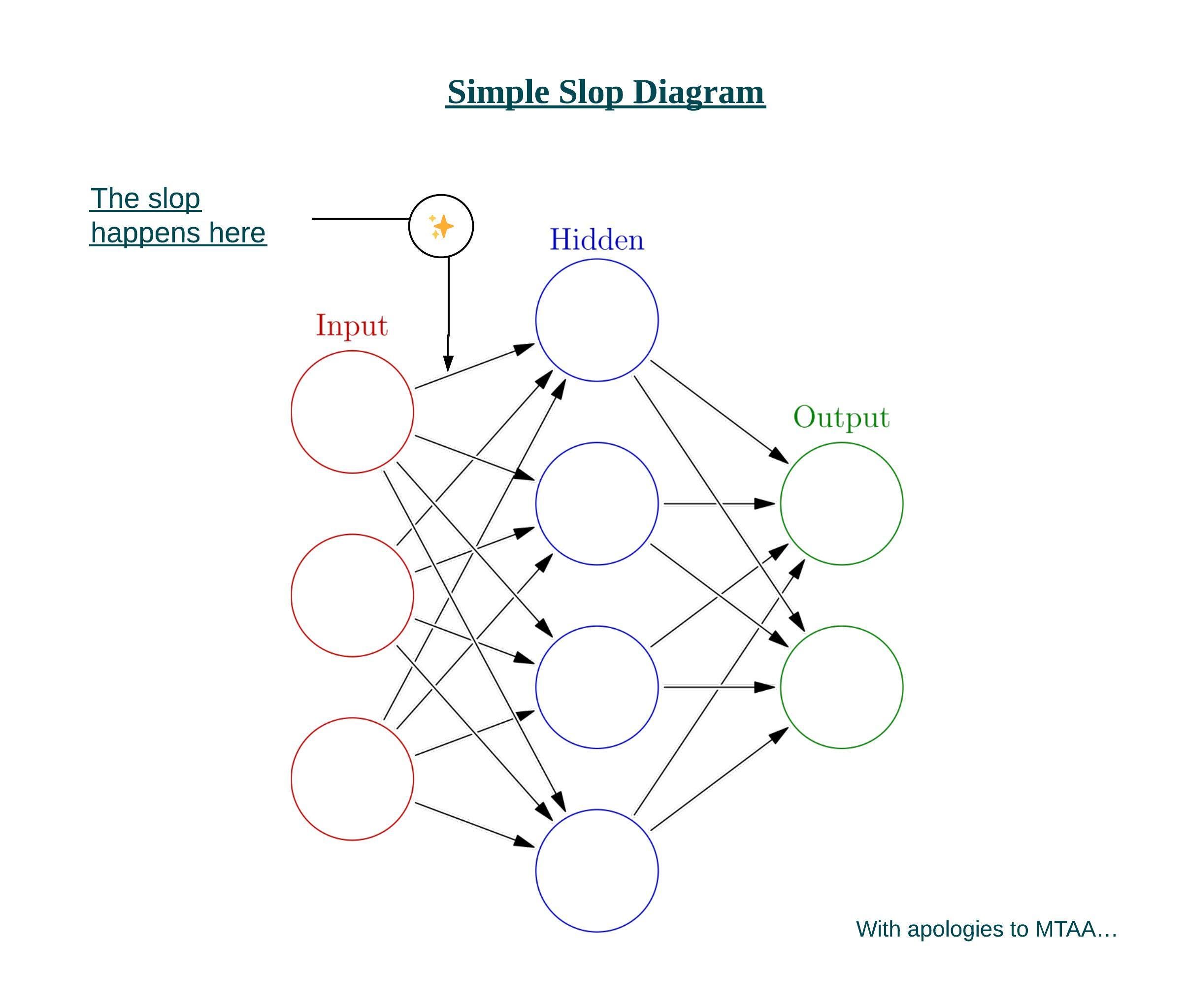
The slop happens here!

Everyone’s got slop on the brain. We debate what constitutes slop, why it’s bad, and how we might fight it. Since 2022 many a theorist/writer have contributed substantially to this question. I even briefly had the idea to collect everyone’s thoughts into a single slim volume On Slop. But I stopped short — because, I admit, sometimes I wish we would stop talking about AI and just get back to being critics of art outside the unholy nexus of art and technology. “May you live in interesting times,” they said.
Let me get right to my point about slop.
When we ask “what is slop?” we’re asking the wrong question.
Instead we should ask “when do we slop?”
What follows is a conceptual statement of something I’ve been teasing for a while: the idea of being a slop materialist.
Are you a slop materialist? I think you are. Read on to find out!
But first, this all started thanks to an excellent pamphlet on AI and creative from the Mozilla Foundation: Imagine Intel: Creative Purpose at the Dawn of AI. It set out to temper the tone on the debate among AI and its incursion into our humanist institutions of art and creativity. I found much of it searching and valuable. In part, it asks that we decouple the risks of AI threats to our economic opportunities from its risks to our personal and collective creative processes. Though they may be linked, we only stand a chance if we split these out.
They summarized this nicely:
“What AI companies make us think: you only lose if you don’t play”
“What we should actually think: who makes the rules?”
The pamphlet leaves us with this call:
“The question isn’t whether AI belongs in creative practice, but how we should position ourselves in relation to it, and what worlds we chose to build”
I think it does us a great service to reorient creativity in constructive terms. I too think we human creators hold the cards, much in line with my wholehearted belief that no new technical innovation is ever inevitable nor pre-determined. We have power and agency despite the many odds stacked against us.
However I have a few notes of caution while we work through these questions. First, since none of this is inevitable, many of us might never chose to nor need to decide on a proper role for AI in our creative practice. So, I would add to their conclusion: It might also just not belong in creativity at all, and maybe it doesn’t really belong anywhere where the human reigns supreme.
The next area of caution is to be highly specific and materially driven when we categorize what constitutes AI production. This is the primary motivation for this post.
“AI” is a purposefully vague umbrella term that is wielded primarily for marketing purposes. Today, companies selling AI are attempting to extend that marketing by arguing that we have always had crappy cultural slop — AI is just the latest tool that may or may not aid in its production.
I think this is misleading and ultimately the wrong way to understand our relation to AI production, and to AI’s primary contribution to society: a newly virulent and careless brand of AI produced slop.
Given this, I appreciate how the conclusion of the Mozilla research stresses the materiality of our slopification. Their timeline of slop starts after the rise of GANs, sometime around the first Obama deepfake.
Elsewhere, however, I see a broader effort to divorce the term “slop” from its genAI production. I think it’s critical to be specific about AI slop’s definition. We hear about “millenial slop bowls”, pigs in slop; we can’t ignore that things done “sloppily” have existed since at least middle English where it meant “a muddy place.” On the one hand you have slop re-emerging as a synonym for mass culture, muzak, or cheap filler. Were sitcoms just 90s slop? Grindslop. Tasteslop! Everyone from serious intellectuals like Ruby Justice Thelot, Holly Herndon, Drew Austin, Sean Monahan down to the obvious culprits behind a series of A16z twitter trolls seem to want to say that the pre-history of slop is just as important as the GANs. I only agree partially. Slop’s birth has less to do with the early neural networks, thinking machines, or Turing tests than it does with the meteoric rise of digital media platforms — without the user-generated content/data, incentives, and mechanisms of social media attention economies, slop would not make sense socially, nor would it be possible computationally. But anything before that — sitcoms, muzak, or the penny dreadfuls — only looked like slop in that they were low-effort and mass scaled. They lacked a critical component: AI slop might feel familiar, but the key is the material root of the process of creation.
As stated above, I want to propose that the mistaken, broad definition of slop emerges because we’re asking the wrong question. The question is not what is(was) slop, but when is slop? When in the creative process do we slop?
The Product Problem
The main way the “we’ve always had human slop” argument errs is that is fetishizing the end product at the expense of the process by which any art gets produced. Art and creativity describe our relationship to processes and labor, not discrete, existing objects or end states. This is to be expected from those who tend to view everything as information manipulatable by mechanistic processes. In reality, creativity is found, relationally, among a series of works acted out by humans. These are almost always aided by tools that extend and apply their thoughts and actions.


The tweet above is a common expression of this fallacy. The guy can’t see past the formal similarities of the end state in order to appreciate the institutional, relational, human process that led us here. The simple fact that a human Bob Ross scrawled out this mediocre, formulaic painting already makes it infinitely more worthy of consideration. Again, sorry, but how am I actually having to make such basic observations? Don’t get me started on the Revenge of the Two Cultures.1
The focus on the end product of slop reflects the technology brother’s mistaken conflation of the final work — the image file, the object, the audience reaction — as the paramount, and in some cases, only register for art and creativity. Our STEM-brained brethren never meaningfully entered into any kind of discursive relationship with creativity. They see it as a means to an end. For them, creativity is a mere function ending in “creative.”
When do we slop?
Asking when we slop re-centers the productive process, making it clear where in the process the model took command. By isolating this component, we are able to distinguish AI slop from other forms of low-effort mass cultural production.
This relies on a technically grounded definition of slop. The primary reason is this is the only objective way to determine what might constitute slop from pre-generative cultural output. The latent space of the generative model is the smoking gun. The slop happens there.
My proposal is that we slop anytime we engage a model as a part of the production process. We should treat slop like a material, as part of the process used, like we would refer to painting — a process and an end result, or textile art, a “genre” driven by its dominant material, and yet, also a final product.
Slopping happens when you ask a private company to provide a service of thought to your uniquely personal and embodied act of creation. In this way, slop must be a kind of zero tolerance endeavor. The slop happens at the neural network level, in the latent space, because that is the most elemental, discrete, and identifiable location where the thinking is simulated. No matter what you create, this is where you have slopped. Think less of the final product’s accidental likeness to previous works, or its reliability to produce work at scale, and more about the simple fact that gen AI wanted to sell you thinking as a product, and you, as a creative human in the world, took the bait.
To borrow from MTAA’s 1997 gif “Simple Net Art Diagram” I’d like to propose a slop update.
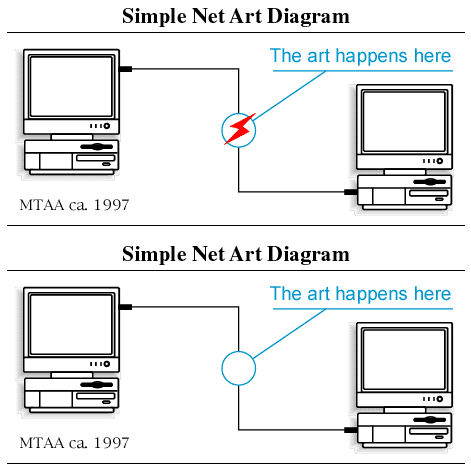
Rhizome’s Net Art Anthology website nicely explains how MTAA’s Simple Net Art Diagram’s significance lay in the way it —
“conveys complex concepts about net art: first, that it “happens,” and therefore can be thought of as an action or a performance; and second, that it is defined by in-betweenness.”2
Both the idea that the net art “happened” as an action or performance, as opposed to it rendering as a fixed object, and that it is defined by the slippage or transfer between states apply to slop materialism.
When did you slop?
We slop when we cede control to the latent space between nodes on a neural network. If I were to be more specific about the vectors of control in question, I would add things like composition, relationships among elements, the birth of concepts involved, shape, timing, and sequencing. I’m sure you can think of more unseen components of the creative process that you subconsciously read when encountering any aesthetic work. All of these many little choices comprise the creative act across nearly every discipline, and the generative AI model architecture supplies them even when they were not specifically prompted to be supplied. Thus, it becomes impossible to retrace how the machine interceded in these (and many more) silent and invisible parts of the creative process anytime we fire up the model.
We could go on. What constituted the style of the work? Where was that allocation made? What about your intent? Does this element carry a purpose? What is it? Who decided, and why? This construction - did you arrange this? How are all of these a reflection of your expression of the work’s overarching purpose? It is possible for there to be a match that is “likely enough” from your intent to the end product, but slop is the condition where this alignment occurred as an accidental outcome. Simply matching a hazy sense of the finished product with an acceptable result of a genAI process is not creativity, it is data analysis.
This is why the technology brother so desperately clings to taste as a concept. Taste is a consumptive state. It is an audience modality, not a productive force. Taste is partially relied upon in the act of creation, but it is always one step removed from the cognitive load employed in the definitive elements of the act of creation. What’s worse, taste is hard won through experience, and the best arbiters of taste built it through a deep understanding of how component elements work together to complete the final object. When these processes retreat to the hidden layer of the gen AI model, we slowly lose our grip on distinguishing what even might constitute taste. After a few generations, taste becomes pure sense, leaving the mind and returning only to the body. Taste as a concept itself will cease to even be utterable or reconstructable because it will reside in the model’s hidden layers.
Marx has a great quote on this from Capital.
“A spider conducts operations that resemble those of a weaver, and a bee puts to shame many an architect in the construction of her cells. But what distinguishes the worst architect from the best of bees is this, that the architect raises his structure in imagination before he erects it in reality.”
Generative AI’s reliance on inhuman combinatorial power is both the utility it delivers and the functional reason it renders the process to a chance that is outside of the user’s vision. Marx’s bee, here, is the blind, hidden layers of the model. The architect stands above this productive process for their cognitive ability to closely map their intent, actions, and designs towards a final imagined goal. The bee is just following orders of an internal “model.”
This categorization insists on a material view of slop, that focuses on the materials used in production. This is again contrasting with the cultural object definition of slop, which is happy to overlook production processes to ex post facto compare cultural objects in a decontextualized imagined space.
Now I understand that there are many other examples in previous creative products where we give up control both to other people or to the apparatus. But it is only in generative AI where we remain unsure of the degree to which these components will be supplied. And it is only with AI where this process de-humanizes in that it drastically constrains and trains on the governed mediation of the user ←→ model relationship. You are not using the tool; the tool is using you.
Comparing it to a slot machine is even too linear. With a slot machine you give up to chance, but the result will always be within pre-set bounds, much like the mechanization of other media (like using a camera to take a photograph). With a slot machine and a Canon R10 you roll the dice, but you enter with a set of expectations and you are creatively at peace with the spectrum of results. There is nothing so linear about working with generative AI, no matter how fine tuned the model or laborious the prompt.
With a gen AI model, it’s a kind of a surreal machinic infrastructure from where we cannot meaningfully predict or even expect what the large language model will produce. That is essentially the artificial part. That is the main value proposition that by giving up to the model, you will get a kind of inhuman unpredictable, specifically, currently knowable result.
Rubrics of Slop Materialism
Let’s map this out. AI slop is the singular, material cause for “slop” in that it lacks three categories of things that only generative AI has ever attempted to remove from creative processes.
An embodied experience - AI cannot feel, think, or know. AI systems have no body. It’s renting yours. Yet again, unlike other tools (recall AI only appears to be a tool and is actually a fully integrated system on which you are the tenant) its end product mimics this embodiment, or worse, performs back to you that your experience is matched by its token prediction.
Precision intent - Rather obviously, you engage in a lossy slipperiness with every un-uttered or imperfectly recounted description of your intent. This problem rarely existed with such risk prior to AI models. Now, it is their primary utility. Gen AI masks and ignores this. It just wants to retain you as a user/paying customer.
A world model, that is, a persistent model of really-existing objects and their relations whose coordination impacts external objects and people outside of itself…the essential stuff of aesthetics, really! — AI attempts to intercede with a world model and world model-reliant creative tasks where it so clearly lacks one. This is well documented in the technical literature, and potentially the reason many generative AI architectures we now use stall. Our cultural institutions are our most reliable (meta) world models, and they are not easily replaced. Shoehorning AI into your creative workflow will only distance your intent from the finished product and impoverish your relation to the institutions that birthed your practice.
In review
You slop when you give up your body to the idea that it can be replaced with network of nodes processing data. Again, this has no technical precedent. And, again, I know people are trying to make historically and technically inaccurate ex post facto rationalizations around artists tools being extensions. But none of these promised to fraudulently appendage the birth of the concept, the thought, or the intent and its resulting design. With pre-AI tools, you always had to actively and precisely strap on the appendage to make your point. The appendage announced its use case and effect, so you chose it with confidence. With a model, you might wake up with a phantom appendage.
To break it down further, slop’s production needs three essential elements:
To start, a conscious actor who fraudulently desires a cognitive disguise for some part of their process.
In the middle, disembodied data and a purely mathematical reduction of inputs and outputs via the space in the hidden layers of the model.
Lastly, at the site of publication, a cavalier carelessness about the resulting artifact.
Gen AI severs these several crucial human steps. The sense-making generated from human creativity requires an institutionalization of that labor. Slop’s primary utility lies in its destruction of this institutional (or even platform) encasement. It is a production with no stage, because it originated from a form of generation that has no human substrate outside of the distantly aggregated training data.
This newsletter was supported by Imagine Intel, the zine and cultural artifact published by Mozilla Foundation to accompany the Imaginative Intelligences Assemblies work led by the Foundation’s Creative Futures program. Check out the work of The Counterstructural Commons, Mozilla Foundation’s cultural R&D residency at Rhizome.
Potentially my second book?
https://anthology.rhizome.org/simple-net-art-diagram